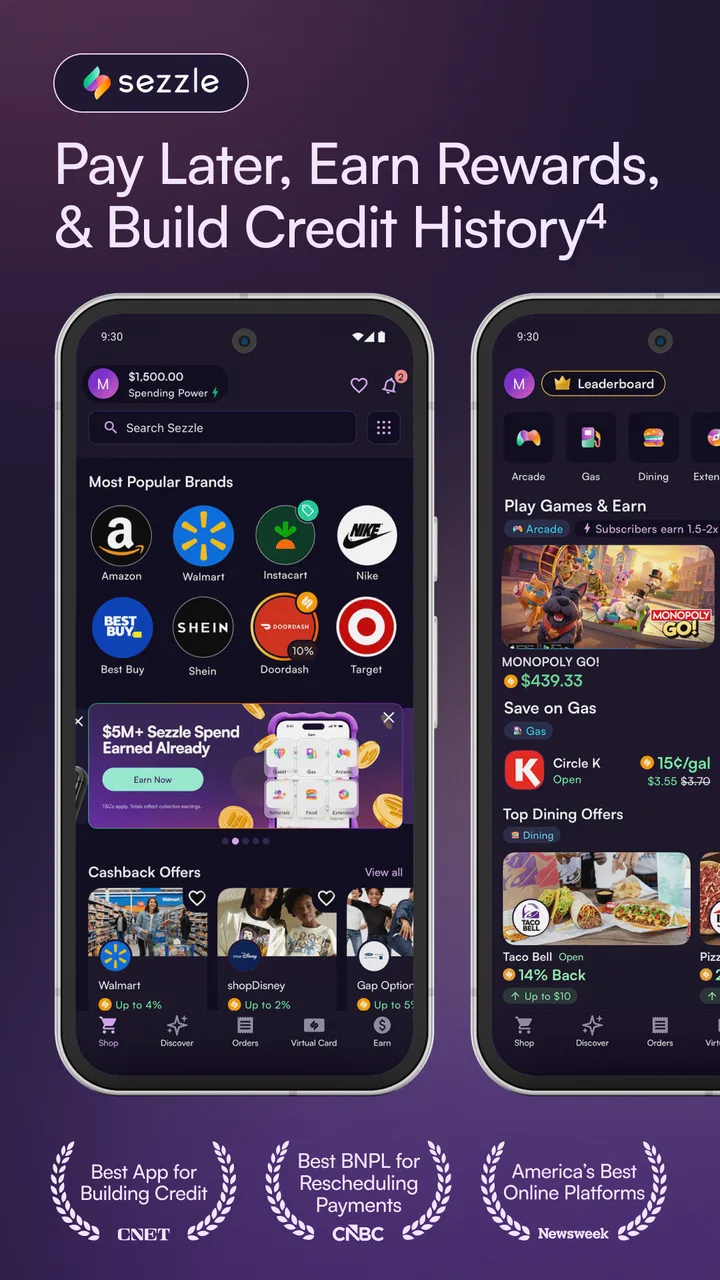
Sezzle: Buy Now, Pay Later
- 4.6
- Rating
- 5.00M
- Installs
- Free
- Price

 Analysis by App-foxy
Buying something online can feel simple until the payment screen asks me to choose between paying everything immediately or walking away. Sezzle approaches that moment as a shopping and payment app built around paying over time, and I found its appeal easiest to understand when I treated it as a budgeting tool rather than as a reason to buy more. The app is free to download, carries an Everyone age rating, and is developed by Sezzle Mobile.
My overall impression is that it is most useful when I already know what I need and want a clearer way to spread the cost. It is less convincing when I am shopping impulsively, working with an unreliable connection, or trying to keep my finances as simple as possible. The experience depends heavily on live communication between the app, the retailer, and the payment process, so connectivity is not a background detail here; it affects whether the checkout feels smooth or suddenly uncertain.
How Sezzle fits into real shopping
The app belongs to the shopping category, but I would not describe it as a normal marketplace where browsing is the main event. Its practical role is to help me manage eligible purchases through a pay-over-time arrangement. That distinction matters. If I want product discovery, price comparison, or a broad catalog in one place, a retailer app or a general shopping platform may feel more natural. If I have already selected an item and want to examine the payment choice, this app has a more focused purpose.
You May Also Like

 Blood Strike: 2.5 Anniversary
Blood Strike’s Loadouts Turn Every Drop Into a Tactical Gamble
A close look at Blood Strike’s custom loadouts: how fast access to signature weapons reshapes its battle royale rhythm, rewards preparation, and narrows the gap between fights.

 Pandora - Music & Podcasts
Pandora’s Music Is Easy to Start, but Harder to Recover
Pandora’s strength is its low-effort path from a seed to a station. Its weak spot is how much confidence it asks you to place in connection, setup, and quiet recovery.

 8 Ball Pool
 Is Built on Rivalries, Rematches, and Routine
A close look at the rivalries, rematches, shared routines, and unanswered safety questions that turn a quick pool match into a persistent mobile community.

 Samsung Music
’s Quiet Strength Is Playing What You Already Own
Its reach comes less from spectacle than from dependable access to a personal library. That simplicity is both the app’s strongest retention engine and its ceiling.

 AccuWeather: Weather Radar
AccuWeather Review: A Quick, Clear Forecast for Everyday Decisions
For everyday plans, the best forecast is the one you can understand quickly. AccuWeather makes rain timing, radar, and local conditions easy to act on, with a few trade-offs.

 Hill Climb Racing
Why Hill Climb Racing Still Turns Crashes Into One More Run
A tiny car, a bumpy hill and one more upgrade: Hill Climb Racing keeps resurfacing because its simple chaos makes every near-miss feel personal.
More From Our News Desk
View All News


The store summary presents the service as pay-over-time purchasing with no interest, with the familiar qualification marker attached to that promise. I would read that carefully rather than treating it as a universal guarantee for every situation. Payment timing, approval, eligibility, and the final checkout experience are the parts I would check before confirming anything. The attractive phrase is useful as a starting point, but responsible use still means reading what appears on the actual order screen.
In everyday use, I see the strongest case for a planned purchase that is necessary but awkwardly timed. Imagine replacing a worn pair of work shoes just before a payday, ordering a school item when several other bills are due, or buying a household replacement after an unexpected failure. In those cases, spreading the expense may help me protect cash flow. The important discipline is to decide the total amount first and then ask whether the scheduled payments fit my budget, rather than beginning with the smaller-looking installment.
The app has been available since March 21, 2019, and its current version is 5.0.7. It supports devices running Android 7.0 or later. Those details make it accessible to people using older Android hardware, although an older phone can still create practical problems if its browser, payment components, or system software behave inconsistently. I would keep the device updated as far as it safely allows, especially before attempting a time-sensitive purchase.
What happens when the connection is doing the work
A connected payment app has a different rhythm from a calculator or a notes app. When I open Sezzle to review a purchase, I expect the app to obtain current information rather than rely on a permanently stored screen. Retailer availability, account status, checkout progress, and payment confirmation all make more sense when the app can communicate with the relevant services. That also means a weak signal can make an ordinary action feel ambiguous.
The most uncomfortable moment is not necessarily a visible error. It is the pause after I tap a confirmation button and cannot tell whether the request went through. Repeating the tap immediately may create confusion, while closing the app too quickly can make me worry that I interrupted the process. My practical habit is to wait for a clear result, check the order or account activity when the connection returns, and avoid starting a second checkout until I understand the first attempt.
This is where Sezzle differs from a conventional card wallet or a direct retailer payment. A card payment may already be familiar to me, while a pay-over-time service adds another layer between the purchase and my bank account. The extra layer can be valuable for planning, but it also gives me more status information to verify. I would not rely on a screenshot of an unfinished screen as proof that an order is complete.
Shopping from a crowded train station, a busy café, or a building with poor reception can expose this weakness quickly. The product page may load, yet the final authorization may stall because the connection changes during the transaction. If I know I will be buying something important, I prefer to prepare before leaving a stable network, keep the app open only when needed, and allow time to confirm the result rather than trying to complete everything while rushing.
Using it on a phone without losing control of the purchase
Mobile shopping encourages quick decisions because the entire process fits in one hand. That convenience is helpful when I need to review a payment plan while standing in a store or comparing an item with my existing budget. It can also hide the total commitment behind a short sequence of taps. I find it safer to pause at the final stage and mentally convert the arrangement back into the full purchase amount before agreeing.
A useful workflow is to begin with the retailer’s product details, confirm shipping and returns there, and then use Sezzle for the payment decision. I would not assume that a payment app replaces the retailer’s responsibility for product descriptions, delivery questions, or return instructions. Keeping those roles separate makes it easier to know whom to contact when something goes wrong.
Another sensible habit is to use a larger screen when I need to compare several items or inspect detailed terms. The phone is excellent for a quick review, but small text and a changing connection are a poor combination for a financial commitment. On mobile, I would check the amount, the timing of each payment, and the final confirmation before switching to another app. A few extra seconds can prevent me from confusing a saved cart with a completed order.
Sezzle Mobile has built an app that suits people who do much of their shopping on Android, and the broad device requirement helps it reach users with older phones. Still, compatibility is not the same as comfort. A phone with limited storage, aggressive background restrictions, or an outdated web component may make a connected checkout less dependable. If the app behaves strangely, I would first move to a stable connection, reopen it carefully, and verify the account or order state before assuming the payment failed.
Recovering from a stalled or interrupted payment
The recovery process is the part I would explain most clearly to a friend. If the app freezes, the network disappears, or the retailer page stops responding, I would not immediately retry the purchase several times. First, I would note what I remember: the retailer, the approximate amount, and whether I saw a success message. Then I would reconnect, reopen the app, and look for the current status. This approach reduces the chance of creating duplicate attempts or misunderstanding a temporary display problem.
If the purchase does not appear, I would check the retailer separately before trying again. A retailer confirmation, an order record, and an in-app status may not update at precisely the same moment. That delay can be frustrating, but it is a reason to verify rather than guess. If the retailer shows an order while the payment app looks incomplete, I would keep those details together when seeking help.
Returns and cancellations are another reason to slow down. The purchase involves both the retailer and the payment service, so I would follow the retailer’s process for the product issue while keeping an eye on the payment arrangement. I would not assume that returning an item automatically means every related payment screen changes instantly. The safest approach is to retain confirmation messages and review the account after the retailer acknowledges the change.
This extra attention is a genuine trade-off. The app can make a planned purchase easier to fit into a budget, but it asks me to monitor a payment relationship rather than simply handing over a card and forgetting about it. That may be perfectly reasonable for an organized shopper. Someone who dislikes tracking several upcoming obligations may find a direct payment method less stressful even if it offers fewer budgeting options.
Connectivity, privacy, and sensible data habits
Because the experience is connected, I would use the app selectively instead of leaving it open while browsing for hours. I prefer to decide what I am buying first, then open the payment tool when I am ready to inspect the transaction. This reduces distraction and makes it easier to notice whether the information on screen matches the purchase I intended to make.
On public Wi-Fi, I would avoid treating a familiar network name as proof that the connection is trustworthy. For a payment-related action, mobile data or a private network is my preference when available. I would also avoid sharing account details through messages or screenshots. If I need support, I would use the app’s recognized route rather than responding to an unexpected request for sensitive information.
Data-conscious use also means keeping notifications meaningful. Payment reminders can be helpful because they bring future obligations back into view, but too many shopping prompts can encourage browsing when I had no plan to spend. I would keep alerts that help me monitor a purchase and reduce anything that turns the app into a constant invitation to shop. The best version of this service, in my view, is a controlled payment aid, not a permanent shopping companion.
I would also review the app after changing phones, restoring a device, or switching networks. A fresh login or a delayed synchronization can make an account appear incomplete until the connection settles. Rather than assuming that missing information has vanished, I would wait for the account to refresh and verify the purchase through the relevant records. That small habit is especially important when several orders are active.
Who benefits and who should choose another route
Sezzle is a good fit for a shopper who has predictable income, understands the full cost of each order, and wants payment flexibility for selected purchases. It can be particularly practical when timing is the main problem rather than affordability. If I can comfortably cover the total but prefer to distribute the outgoing payments, the service has a clear role.
I would be more cautious if my budget is already tight or if I regularly forget upcoming commitments. Several individually manageable purchases can become difficult when their schedules overlap. In that situation, paying directly, waiting until the money is available, or using a budgeting method that shows all obligations in one place may be better. The app should not be used to make an unaffordable item appear affordable.
It may also be the wrong choice for someone who wants the simplest possible checkout. A debit card, a credit card, or a retailer’s own payment option may involve fewer moving parts. A traditional credit card can offer a familiar statement and broader use, while direct payment avoids the need to monitor a separate pay-over-time arrangement. The better option depends on whether flexibility or simplicity matters more for the purchase at hand.
The service has significant public reach: it shows a 4.5 average from around 103 thousand ratings and more than 5 million installs. Those figures suggest that many Android shoppers find the concept useful, but they do not remove the need for personal judgment. A popular payment method can still be unsuitable for an individual budget, an unreliable network, or a retailer whose return process is complicated.
My final view after focusing on the connected experience
I see Sezzle as a focused shopping app with a useful but narrow promise. It can help me spread a planned purchase and examine a pay-over-time route from my phone, especially when I am dealing with a temporary cash-flow gap. The free price and Everyone rating make it approachable, and the Android 7.0 minimum means it is not restricted to only the newest devices.
Its main weakness is the responsibility that comes with the convenience. A live connection, a retailer, an account, and a payment schedule all need to line up. When they do, the process can feel straightforward. When one part stalls, I need patience and careful verification instead of repeated taps. That is not a deal-breaker, but it changes how I would use the app: deliberately, on a reliable connection, and with the total purchase amount firmly in mind.
My recommendation is simple: use Sezzle for planned purchases you can already afford, not as permission to stretch beyond your budget. If you are comfortable checking payment status, keeping track of scheduled obligations, and recovering calmly from a weak connection, it is worth considering. If you want one-step simplicity or tend to shop impulsively, a direct payment method will probably serve you better.
FAQs for Sezzle: Buy Now, Pay Later
01What is Sezzle and how does it work?
Sezzle is a buy now, pay later service that allows users to split their purchases into four interest-free payments over six weeks. When you check out with Sezzle, the first payment is made at the time of purchase, and the remaining three payments are automatically charged every two weeks. This provides flexibility and helps manage cash flow more effectively.
02Is there a credit check when signing up for Sezzle?
Yes, Sezzle performs a soft credit check when you sign up, but it won't affect your credit score. This check helps determine your spending limit and eligibility. The soft inquiry ensures that users are financially responsible and able to manage the payments, without impacting their credit history.
03Are there any fees associated with using Sezzle?
Sezzle does not charge interest or hidden fees if you make your payments on time. However, if you miss a payment, Sezzle may charge a small fee. To avoid any charges, it’s important to ensure that there are sufficient funds in your account for automatic payments or to reschedule payments in advance.
04What happens if I can't make a payment on time?
If you can't make a payment, Sezzle allows you to reschedule it once for free. After that, additional rescheduling may incur fees. It’s recommended to communicate with Sezzle’s customer service to explore options and avoid fees. Keeping track of your payment schedule helps prevent missed payments.
05Where can I use Sezzle for purchases?
Sezzle is accepted at a wide range of online retailers across various categories, including fashion, electronics, and home goods. You can check Sezzle’s website or app for a comprehensive list of partnered merchants. As Sezzle continuously expands its network, more stores are added regularly, enhancing shopping flexibility.
Pros
- Flexible payment options for budgeting.
- No interest on payments if paid on time.
- Easy-to-use interface for all users.
- Instant approval process for purchases.
- Wide range of partnered retailers.
Cons
- Late fees if payments are missed.
- Limited to specific retailers.
- May encourage overspending.
- Requires linking to a payment method.
- Not available in all countries.

Sezzle: Buy Now, Pay Later
Gallery